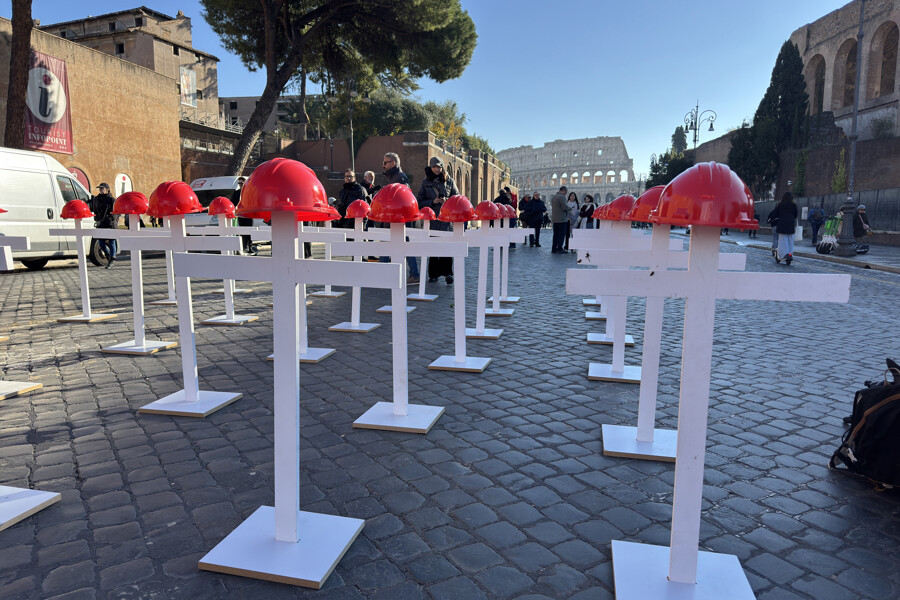
Italy is experiencing a general strike day, organized by the country's largest trade union confederation, CGIL. Protests are taking place in major cities against the budget of Prime Minister Giorgia Meloni's government. CGIL Secretary Maurizio Landini, who led the demonstration in Florence, spoke of 'mass participation' and stated that the marches represent 'workers, pensioners, students, people who have difficulty making ends meet'. 'The only public spending our country plans is rearmament,' the union leader said, denouncing the 'absurd logic of states increasing spending on arms when workers can't make ends meet, wages are low, and the purchasing power of employees and pensioners is being cut.' Rome was also the scene of another march to the Imperial Forums to 'denounce the wrong direction' in which the Meloni government is using public resources, CGIL unionist Maria Mora told EFE. Mora criticized the lack of structural measures against tax evasion and reproached the government for increasing taxes on workers and pensioners instead of taxing 'large fortunes and the extraordinary profits of corporations that don't pay taxes'. The capital's demonstration ended at the Torre dei Conti, where a worker who died in the partial collapse of this medieval building in early November was honored, an event that reignited the debate on workplace safety in Italy. In addition to the demonstrations, the strike had a mixed impact on the country: it paralyzed some urban transport in Milan and Naples, led to school closures and train cancellations in several regions, while services in Rome operated normally, according to Italian media. CGIL estimates that more than half a million people participated in the approximately 50 demonstrations across the country. The government, however, has cited different figures: for example, public sector employee participation was 8.2%, and in the education sector it was only 3.86%, 'one of the lowest in the last three years,' the Education Ministry reported. 'This strike is just another failure for those who continue to distort reality, passing mere partisan interests as the demands of workers,' said Public Administration Minister Paolo Zangrillo. From the political sphere, the far-right League, the party of Deputy Prime Minister and Transport Minister Matteo Salvini, criticized the strike call and insisted on ironically pointing out the 'coincidence' that the mobilization is on a Friday. 'Landini calls a strike (coincidentally on a Friday), while we are increasing salaries for millions of workers in schools, health care, and transport,' the League wrote on social media X. The Transport Minister visited the State Railways' operational center today to assess the strike's impact and stated that 'fortunately, the data is encouraging and the disruptions are very limited.' Specifically, he detailed that high-speed trains between Rome and Milan had no incidents, while the rest of the network maintained 90% of its service, and regional trains guaranteed 80% of the service. 'The only damage caused by Landini is to Italians who, despite the low participation, have had difficulties,' the League concluded in a statement.