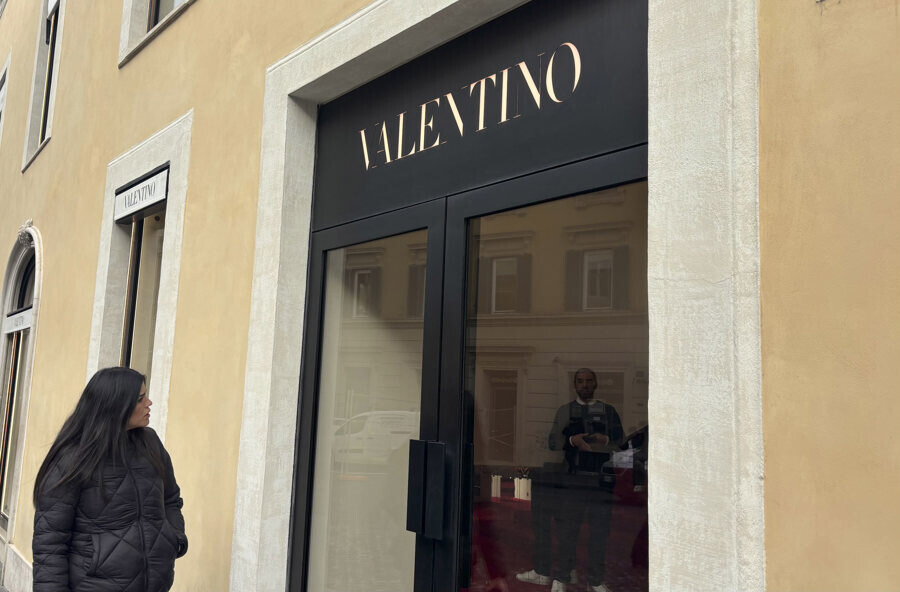
The loss of these two designers confirms a generational shift that Italian design began years ago and marks the end of the era of 'founder-designers' to consolidate a less personalist and more collective model. In just four months, the fashion world has said goodbye to two of its great masters: Armani and Valentino. This loss confirms a generational shift that Italian design initiated years ago and marks the closure of the era of the 'founder-designers' to consolidate a less personalist and more collective model. Beyond the emotional impact of the disappearance of these great figures, Italian fashion design has long been functioning with both established and emerging designers who face challenges such as market speed, the constant rotation of creative directors, or the difficulty of gaining visibility, according to experts consulted by EFE. A transition without 'emperators' 'Valentino and Armani belong to four generations back,' EFE is told by Paola Pattacini, director of the IED Rome Fashion School. In this scenario, the authority of the single creator gives way to more collective structures: 'Neither the creative nor the manager alone can sustain a business; it is the 'dream team' that makes the difference,' adds Saviolo. New talents and current challenges The creative succession exists, but it faces a more demanding environment: the acceleration of the collection calendar, the constant turnover of creative directors, and commercial pressure make it difficult to build a long-term vision. 'Creativity needs time — Pattacini opines — we used to take months to design a collection, today we produce one a month'. Even so, Italy continues to generate designers capable of reinterpreting its legacy, with creative directors like Pierpaolo Piccioli (Balenciaga), Giambattista Valli, Alessandro Michele (Valentino), or Maria Grazia Chiuri (Fendi), alongside emerging talents such as Francesco Murano, Marcello Pipitone, or Luca Magliano who bet on craftsmanship and technical rigor in a market dominated by algorithms and marketing. 'There are many designers, the challenge is for them to find partners who believe in them and allow them to grow,' Pattacini stresses. For Sonia Veroni, founder of the Modateca Deanna archive, the problem of new talents 'is not a lack of creativity, but the difficulty of making themselves visible' in an increasingly competitive market, she tells EFE. 'Saper fare' as true heritage The strength of Italian fashion lies in its productive structure: around 60,000 companies support the 'Made in Italy' value chain, from textile research to final tailoring, guaranteeing a 'saper fare' (know-how) that transcends individuals. Veroni insists that this is the true heritage of Italian fashion: 'if a brand wants to do things well, qualitatively and ethically, Italy remains the place to do it'. A vision shared by professor Saviolo, who emphasizes that 'the product remains fundamental: not just the stylistic vision, but also the manufacturing, the quality, and the transparency of what the consumer pays'. Photo EFE The post The generational shift in Italian fashion: from 'emperators' to the 'dream team' was first published in La Verdad Panamá. 'After them came Ferré, Versace, then Piccioli, Chiuri, Michele. The succession has already occurred, and will continue to occur'. From within the sector, the transition is read as a natural and cumulative process, not as a rupture. Italian fashion, explains Pattacini, has always advanced in layers: 'in the eighties, 'prêt-à-porter' and the big names were born because there were visionaries who bet on them and gave them time'. For Stefania Saviolo, professor of Fashion Strategy at Bocconi University, the great challenge of the system is to transform founder-centric brands into institutions capable of competing with global conglomerates. 'Size is important in this business, and groups — even if they are of a smaller size, like Zegna or Prada — allow for risk diversification and greater solidity,' she tells EFE. – View of the Emporio Armani store in Rome, this Saturday.